
Customer feedback is only valuable when you measure the right thing.
Two of the most widely used customer experience metrics are Customer Satisfaction Score (CSAT) and Net Promoter Score (NPS). They may appear similar, but they answer different questions.
CSAT tells you how customers felt about a particular interaction. NPS helps you understand the strength of their overall relationship with your business.
Choosing the right metric depends on what you want to learn and what action you plan to take.
What Does CSAT Measure?
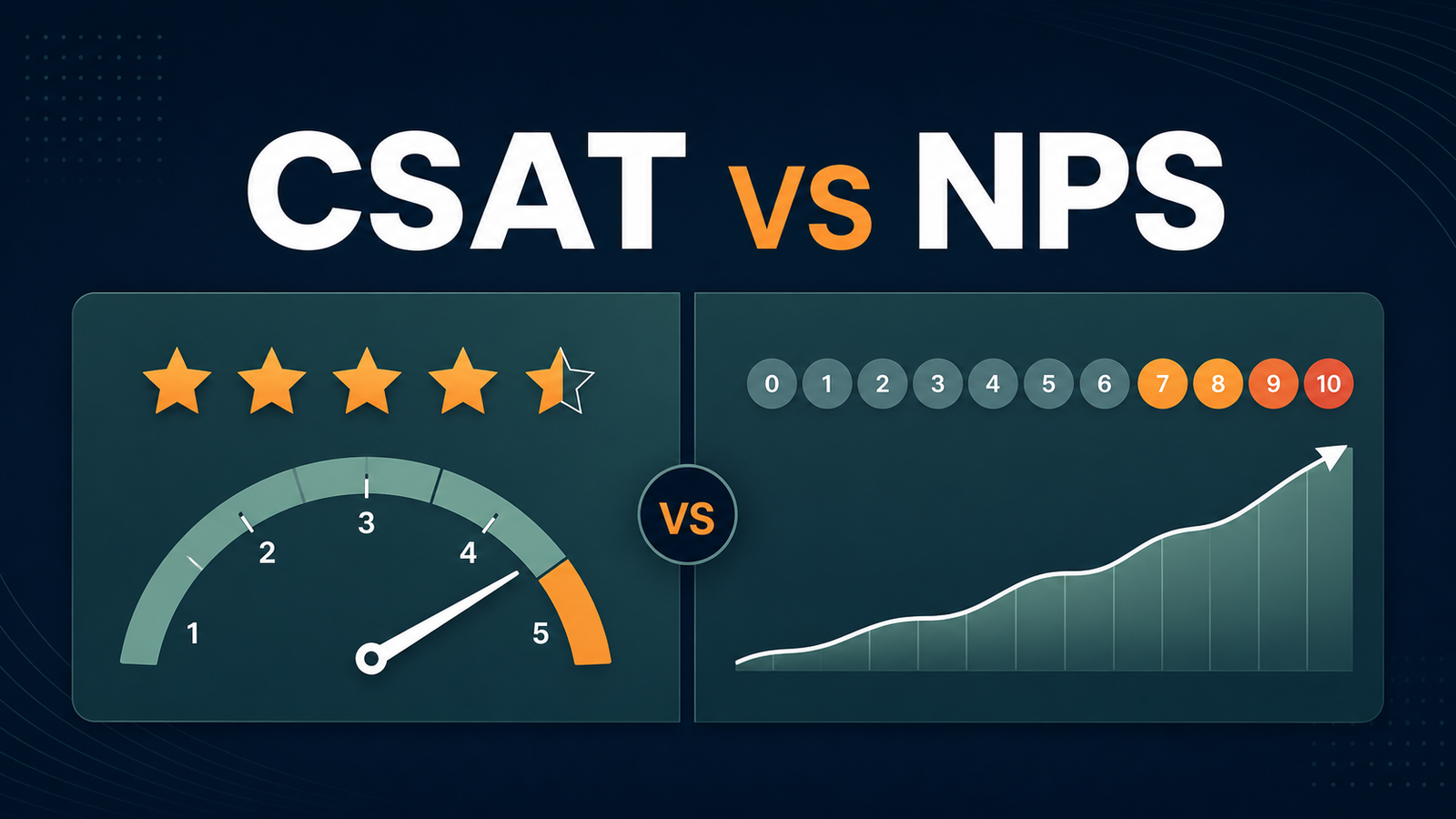
CSAT measures customer satisfaction with a specific product, service, or interaction.
A typical CSAT question is:
How satisfied were you with the service you received?
Customers usually answer using a five-point scale:
- Very dissatisfied
- Dissatisfied
- Neutral
- Satisfied
- Very satisfied
The most common calculation counts the customers who selected 4 or 5, divides that number by the total responses, and multiplies it by 100.
For example, if 80 of 100 respondents selected satisfied or very satisfied, your CSAT score would be 80%.
CSAT is a “right here, right now” measurement. It works best when the survey is sent shortly after an experience while it is still fresh in the customer’s mind.
When Should You Use CSAT?
CSAT is useful after specific customer touchpoints, including:
- A customer-support conversation
- A completed purchase
- A product delivery
- An appointment or consultation
- An onboarding experience
- The resolution of a complaint
Because CSAT focuses on one interaction, it can help you identify exactly where customers are experiencing friction.
A low score after delivery may indicate a shipping problem. A low score after a support call could reveal issues with response time, communication, or problem resolution.
However, CSAT does not necessarily tell you whether a customer will remain loyal. Someone may be satisfied with one interaction but still choose a competitor later.
What Does NPS Measure?
NPS measures the customer’s overall relationship and loyalty toward a business.
The standard question is:
How likely are you to recommend our business to a friend or colleague?
Customers respond using a scale from 0 to 10 and are grouped into three categories:
- Promoters: Scores of 9 or 10
- Passives: Scores of 7 or 8
- Detractors: Scores from 0 to 6
NPS is calculated by subtracting the percentage of detractors from the percentage of promoters.
For example, if 55% of respondents are promoters and 20% are detractors, your NPS would be 35.
Unlike CSAT, NPS is designed to provide a broader view of the customer relationship. It can help you track loyalty and overall brand perception over time.
When Should You Use NPS?
NPS is useful when you want to:
- Measure long-term customer loyalty
- Track changes in the overall customer relationship
- Identify promoters and detractors
- Compare customer segments
- Understand whether customers would recommend your business
- Monitor the effect of broader customer-experience improvements
Many businesses send a relationship NPS survey quarterly, twice a year, or annually rather than after every transaction.
NPS should also include an open-text follow-up question such as:
What is the main reason for your score?
The number shows you what happened. The written feedback helps explain why it happened.
The Main Difference Between CSAT and NPS
The simplest distinction is:
- CSAT measures satisfaction with a specific experience.
- NPS measures the strength of the overall customer relationship.
Imagine that a customer contacts your support team and receives a quick, helpful response. They may give that interaction a high CSAT score.
However, the same customer may still give your business a low NPS score because of pricing, product reliability, or previous negative experiences.
Both scores are valuable, but they examine different parts of the customer journey.
Should Your Business Use Both?
For many businesses, the answer is yes.
CSAT can monitor important customer touchpoints, while NPS can track the overall relationship.
For example, a business could:
- Send CSAT immediately after a purchase or support interaction
- Send NPS every six months
- Include an open-ended question with both surveys
- Track the results in one customer-experience dashboard
Using both metrics helps you understand immediate performance and long-term loyalty.
If CSAT is improving but NPS remains low, customers may be satisfied with individual interactions while still experiencing broader issues.
If NPS is strong but CSAT falls at a particular touchpoint, you may have identified a specific process that needs attention before it damages customer loyalty.
Avoid Measuring Without Taking Action
A score is not the final result. It is the beginning of the investigation.
To turn customer feedback into meaningful improvements:
- Review the written comments behind the scores.
- Identify recurring themes and pain points.
- Compare results across customer groups or locations.
- Follow up with dissatisfied customers when appropriate.
- Assign responsibility for improvement actions.
- Track whether the changes improve future scores.
Customers are more likely to keep providing feedback when they can see that the business listens and responds.
Choose the Metric That Supports Your Goal
Use CSAT when you need to understand a specific interaction.
Use NPS when you want to measure the overall customer relationship.
Use both when you need a more complete view of the customer journey.
The most important question is not which metric is more popular. It is which metric will give you information that your business is prepared to act on.
If you need help selecting the right metrics, designing your survey, or creating a dashboard that turns customer feedback into clear insights, let’s connect.
References: Qualtrics—CSAT vs NPS, Qualtrics—What Is CSAT?, and Bain & Company—Measuring NPS.