

Most businesses measure success by their bottom line. Revenue targets. Profit margins. Quarterly returns. And while none of those things are wrong to care about, obsessing over them above everything else is exactly the strategy that keeps businesses stuck — or worse, drives them into the ground.
The companies that win long-term do not put profit first. They put their customers first. And the profit follows.
This is not a motivational concept. It is a proven, data-backed business strategy — and if you are serious about growing, it is time to take it seriously.
The Data Does Not Lie
In Winning on Purpose, Fred Reichheld tracked cumulative shareholder returns from 2011 to 2020 against the Vanguard Total Stock Market Index. The results were stark. Only the top NPS leaders — the companies most loved by their customers — actually beat the market. Discover Financial delivered a return of 185. JPMorgan Chase came in at 111. The companies that neglected their customer relationships returned as little as 12, against a market average of 100.
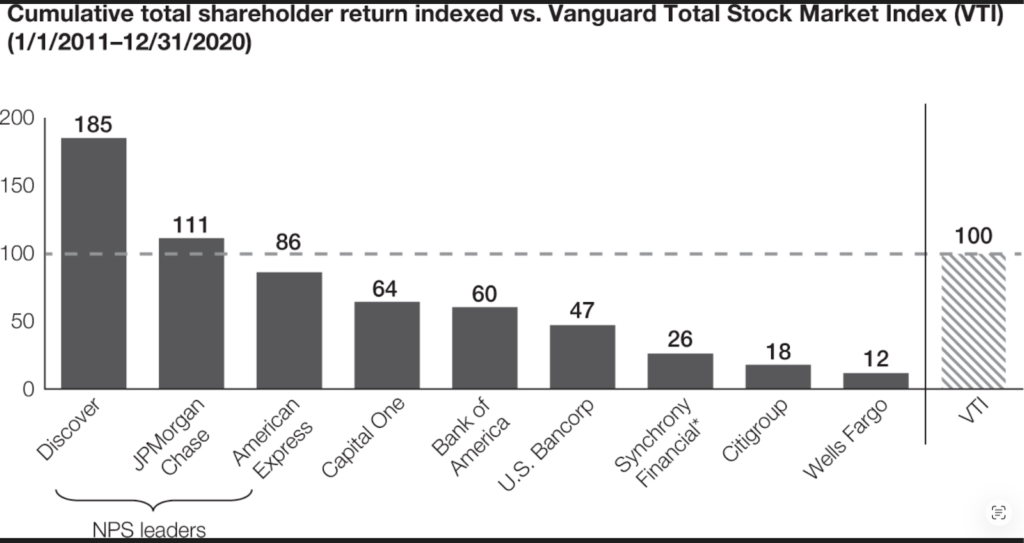
The businesses that made customers love their core strategy did not just survive — they dominated. If you needed proof that a customer-centric approach drives real financial results, this is it.
Costco: A Masterclass in Putting Customers First
When Reichheld sat down with Costco co-founder and longtime CEO Jim Sinegal, he asked how he responded to Wall Street’s criticism that Costco paid too much to employees and kept prices too low. Sinegal did not flinch: if you try to run a business following Wall Street’s advice, you will not be in business very long.
Sinegal’s priority list was customers first, employees second, shareholders last. And by putting shareholders last, Costco delivered total returns that far exceeded the S&P 500 since going public in 1985.
Costco never marks up a product more than 14 percent — passing every saving directly to its members. When Wall Street pushed back, Sinegal held firm. Members trust Costco completely, and breaking that trust would change the entire nature of the company. That trust — not its warehouses or product range — is Costco’s greatest competitive advantage.
The Winners All Have One Thing in Common
Costco is not a lucky exception. Apple built one of the most valuable brands in history by obsessing over the customer experience at every touchpoint. T-Mobile transformed a struggling carrier into a market leader by eliminating the pain points customers hated most. American Express has maintained fierce loyalty for decades by consistently delivering more value than its competitors.
None of them won by accident. Customer-centricity was a deliberate, non-negotiable operating principle — not a marketing tagline.
The Cost of Getting This Wrong
Every customer who walks away unhappy is not just lost revenue. They are a story being told to others — to colleagues, their network, their social media followers. A business that does not prioritize its customers does not just stagnate. It bleeds.
And the inverse is equally true. A customer who feels genuinely valued does not just come back — they bring others with them. That is organic growth, and it is the most powerful, cost-effective engine available to any business.
What This Means for You
As a small business owner, you have an advantage that large corporations spend millions trying to replicate — direct, personal access to your customers. But proximity is only an advantage if you use it.
The question is not whether customer experience matters. The data has already answered that. The question is whether you are willing to make it your priority before your competition does.
Ready to understand what your customers are truly experiencing? A Customer Experience assessment gives you the clarity to act — and the strategy to grow. Let’s connect.
Source and inspiration: Winning on Purpose: The Unbeatable Strategy of Loving Customers by Fred Reichheld, Darci Darnell, and Maureen Burns (Harvard Business Review Press, 2021). The analysis and recommendations in this article reflect my own interpretation.